The Visa Divide
2025 World in Data
Where you can go depends on where you were born. We analyzed data from 199 countries to see how deep the divide runs.
best & worst passports
visa requirements database
Denmark (best)
Syria (worst)
The Passport Lottery
Where you can travel has little to do with you. It has everything to do with the country on your passport.
Someone from Denmark has easy access to 184 countries. Someone from Syria? 73.
Select a country below to see how the map changes. Click any destination to view detailed visa requirements.
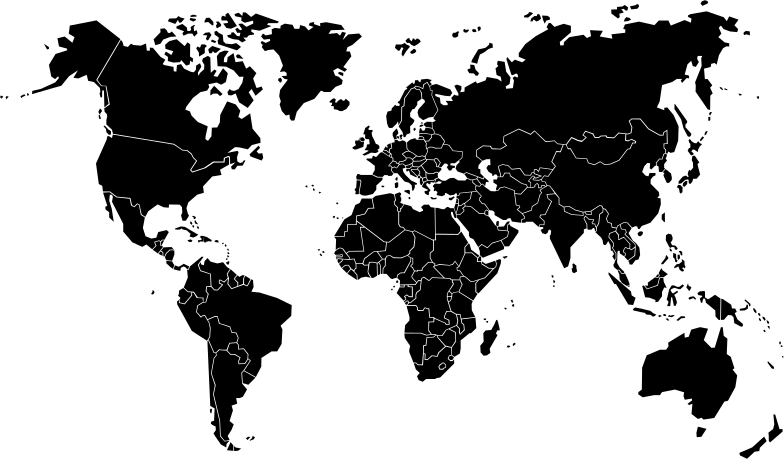
Global visa access by passport
Select a passport to see visa requirements for every destination. Click a country for details.
Most powerful passports
- 1. Denmark 184 destinations
- 1. Spain 184 destinations
- 1. United Arab Emirates 184 destinations
- 4. Austria 183 destinations
- 4. Belgium 183 destinations
Least powerful passports
- 199. Syria 73 destinations
- 198. Afghanistan 76 destinations
- 197. Somalia 78 destinations
- 196. Iraq 79 destinations
- 195. Yemen 80 destinations
The Inequality Index
Pick two passports. See the gap.
The divide has widened over the past decade. Rich countries keep adding visa-free deals with each other. Everyone else waits in line.
The top 20 passports average 180+ destinations with easy access. The bottom 20 average around 80.
Compare two passports
Pick any two of 199 passports to compare
↑ Biggest Gainers (Last Decade)
- UAE +72 ranks
- China +34 ranks
↓ Biggest Decliners (Last Decade)
- United States 2nd → 9th
- United Kingdom 1st → 9th
Who Gets Rejected
Having a visa option doesn't mean you'll get one. Your odds depend heavily on your passport.
Schengen countries received 11.7 million applications last year and rejected 14.8%. But that average hides a lot.
Bangladeshi applicants get rejected 54.9% of the time. Russians? 7.5%. Same visa, same rules, 7x the difference.
Schengen Visa Rejection Rates
By applicant nationality, 2024
Source: European Commission, 2024. Rejection rate = applications refused / total decisions.
U.S. B-Visa Refusal Rates
By applicant nationality, 2024
Source: U.S. State Department, 2024. Adjusted refusal rate for B1/B2 visas.
A Bangladeshi applying for a Schengen visa is 7x more likely to be rejected than a Russian.
The Student Squeeze
Studying abroad is getting harder. U.S. student visa denials hit a 10-year high in 2024.
Last year, 41% of F-1 student visa applicants were denied. A decade ago, it was 15%.
The UK is tightening too. Student dependent visas dropped 84% in one year after new rules kicked in.
U.S. student visa denials have nearly tripled
F-1 visa rejection rate, 2014-2024
- • Stricter "ties to home country" rules
- • More scrutiny of return intent
- • Higher financial proof requirements
- • Post-pandemic backlogs
- • Bangladesh: 58.5%
- • Nigeria: 52.8%
- • Pakistan: 48.2%
- • India: 38.2%
Source: U.S. Department of State, Cato Institute analysis. F-1 student visa statistics for fiscal years 2014-2024.
The Wait
Even when approval is likely, you might wait a year just for an interview.
Want a U.S. visa interview in Calgary? Get in line for 24 months. Chennai? 14 months. Paris? About a week.
High-demand consulates are overwhelmed. Low-demand ones process applications in days.
Visa wait times around the world
U.S. B1/B2 visa interview wait times by city
Why the big differences?
India, China, and Mexico send the most applicants but have limited consular staff. Chennai alone handles hundreds of thousands per year.
UK, French, and German citizens rarely need visitor visas, so their consulates have almost no backlog.
Some applicants interview at consulates in countries with shorter waits, like Singapore or Dubai. It's allowed, but has trade-offs.
Source: U.S. Department of State visa appointment wait times, as of July 2025. Wait times are for B1/B2 visitor visa interviews.
Explore the Data
Check visa requirements for any country pair, compare passports, or browse by destination.
Methodology & Sources
Data sources
- Passport Rankings: VisaBeat Visa Matrix covering 199 passports and 198 destinations per passport.
- Schengen Statistics: European Commission Migration and Home Affairs, 2024 annual visa statistics.
- U.S. Visa Statistics: U.S. Department of State Bureau of Consular Affairs, FY2024 adjusted refusal rates.
- Student Visa Data: U.S. State Department and Cato Institute analysis.
- Processing Times: U.S. State Department visa appointment wait times (July 2025).
Definitions
- Mobility Score: Number of destinations with easy access (visa-free + visa on arrival + eVisa).
- Rejection Rate: Applications refused divided by total decisions (issued + refused).
- Processing Time: Wait time for visa interview appointment, not total processing time.
Limitations
Rejection rates may be influenced by self-selection (applicants from high-rejection countries may be more cautious), application quality variations, and different visa categories. Processing times change frequently and vary by visa type.
Download the Data
All data used in this report is available for download. Please cite VisaBeat if you use this data in your research or reporting.
Need visa help for your trip?
Check requirements, fees, and processing times for your specific route.
Search Visa Requirements