The Maduro Operation
A sourced analysis of the U.S. military action in Venezuela, how 63 nations responded, and what the scenarios ahead look like.
What Happened on January 3
Reuters reported that strikes hit multiple areas including Caracas and nearby states, with Venezuela's government condemning the action as "military aggression" and declaring a national emergency.[2] AP described the operation as a lightning raid that removed Maduro and his wife Cilia Flores, transporting them to the U.S. to face criminal charges.[1]
President Trump stated the U.S. would "run" Venezuela temporarily during a transition.[1] U.S. Deputy Secretary of State Christopher Landau described the event as a "new dawn" for Venezuela.[21]
Oil infrastructure intact
PDVSA-linked sources told Reuters that production and refining facilities were not damaged, though the port of La Guaira suffered severe damage.[3]
Exports already strained
A December U.S. blockade and seizures roughly halved exports from November levels, forcing PDVSA into storage workarounds.[3]
Inside the Operation
Scroll through an interactive timeline of Operation Absolute Resolve, from the first strikes at 02:01 VET to Maduro's extraction 2.5 hours later.
The Buildup
August - December 2025
For months, the U.S. military quietly encircled Venezuela. Ships positioned in the Caribbean. Aircraft staged in Trinidad and Puerto Rico. By late December, an armada of 150+ aircraft and thousands of troops stood ready.
02:01 VET
First Strikes
At 2:01 AM, F-35s and B-1B bombers struck simultaneously. Primary targets: La Carlota Air Base, Fort Tiuna military headquarters, and communications at Cerro El Volcán. Venezuela's air defenses were overwhelmed in minutes.
The Night Stalkers
160th SOAR Insertion
Under cover of the airstrikes, MH-47 Chinooks and MH-60 Black Hawks from the 160th SOAR flew Delta Force operators into Caracas. One helicopter took fire from ground defenses but continued its mission.
The Extraction
Miraflores Palace - 03:45 VET
Delta Force operators breached the presidential palace. Nicolás Maduro and his wife Cilia Flores were captured and secured. The ground operation took less than 30 minutes.
Exfiltration
To the USS Iwo Jima - 04:21 ET
The extraction team flew Maduro out over the Caribbean to the USS Iwo Jima. Trump posted a photo of Maduro aboard the ship: blindfolded, wearing earmuffs, holding a water bottle. Operation Absolute Resolve was complete.
How the World Reacted
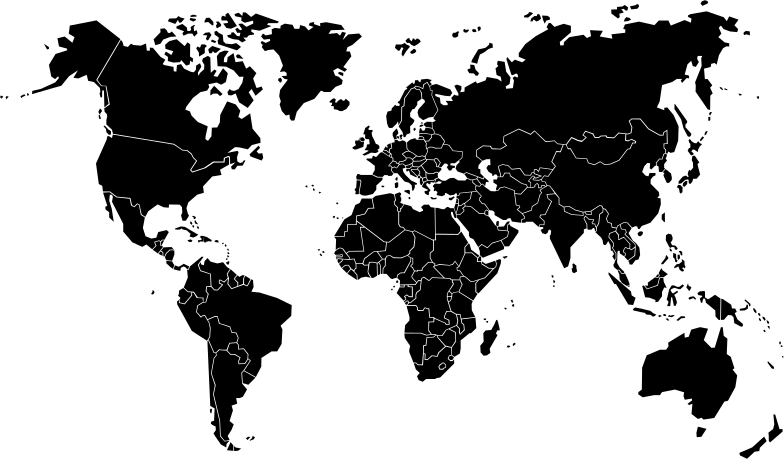
63 nations issued statements. 130 have not yet responded.
Global Response Map
Hover or click a country to see details
Condemned (18)
"Act of armed aggression against a sovereign state"
Demanded immediate clarification from Washington. Called for emergency UN Security Council session. Expressed full solidarity with Venezuelan people. Warned the action sets a dangerous precedent for international relations and could destabilize the entire region. Emphasized that Maduro remains the "legally elected president."[25]
"Grave violation of international law and Venezuela's sovereignty"
Strongly condemned U.S. military intervention. Urged the U.S. to immediately respect the UN Charter and basic norms of international relations. Called for peaceful resolution through dialogue. Noted China's long-standing partnership with Venezuela and commitment to non-interference in internal affairs. Warned action threatens regional peace and security.[25]
"The United States has crossed an unacceptable line"
Issued statement describing the action as a dangerous precedent that threatens the sovereignty of all Latin American nations. Temporarily closed border with Venezuela, then reopened. Warned of potential massive refugee flows into Roraima state. Called for immediate de-escalation and dialogue. Refused to recognize any U.S.-backed transitional authority without broad international consensus.[14]
"Unilateral military action violates international agreements and regional peace"
Strongly condemned the operation as a violation of the UN Charter and OAS principles. Called for peace, dialogue, and respect for sovereignty. Offered Mexico City as a neutral venue for negotiations between all parties. Urged the United Nations to take an active role in preventing further escalation. Emphasized Mexico's historic commitment to non-intervention doctrine.[28]
"I alert the world to this attack on our neighbor"
Expressed deep alarm at military action on Colombia's border. Emphasized urgent need for peace and respect for international law. Announced preparations for potential massive refugee influx from Venezuela. Called for emergency meeting of South American leaders. Warned that regional destabilization could affect all neighboring countries for years.[21]
"Blatant violation of sovereignty and international law"
Strongly condemned what it called "American imperialism and aggression." Encouraged Venezuelans to resist foreign intervention. Drew parallels to U.S. interventions in Middle East. Expressed solidarity with Venezuela as a fellow nation facing U.S. pressure. Called the action a "naked display of hegemonic ambition."[26]
"Brutal imperialist aggression against the Bolivarian Republic"
Issued one of the strongest condemnations, calling the action "state terrorism." Expressed full solidarity with Venezuela and the Maduro government. Mobilized diplomatic channels to rally international opposition. Warned this could be a prelude to broader U.S. intervention in the Caribbean. Called for global condemnation of "Yankee imperialism."[29]
"Criminal aggression against the Venezuelan people"
Denounced the U.S. military action as a flagrant violation of sovereignty and international law. Expressed unconditional solidarity with Venezuela. Called for unity among Latin American nations against "imperial interference." Warned that Nicaragua and other nations could face similar aggression.[29]
"We reject this act of aggression"
Condemned the military intervention as a violation of international law. Expressed solidarity with the Venezuelan people. Called for dialogue and peaceful resolution. Warned of destabilizing effects on Central American region.[29]
"Flagrant aggression"
Condemned the U.S. action as another example of American violation of sovereignty. Drew parallels to U.S. interventions in Syria. Expressed solidarity with Venezuela.[29]
"Gangster-like military aggression"
Strongly condemned U.S. action as "state-sponsored terrorism." Expressed solidarity with Venezuela against "U.S. imperialist aggression."[29]
"Armed aggression is a direct threat to international peace"
President Lukashenko "categorically condemned" the strikes. The Belarusian Ministry of Foreign Affairs described U.S. "armed aggression" as a "direct threat" to international peace and security. Aligned response with Russia in condemning the operation.[29]
"Another example of Western imperialism"
Mali's military government condemned the operation as Western intervention. Already in conflict with U.S. over visa restrictions, Mali has banned U.S. citizens from entry since January 2026. Expressed solidarity with Venezuela against "imperial aggression."[29]
"Violation of sovereignty we cannot accept"
Burkina Faso's military junta condemned the operation alongside Mali. Has implemented visa bans on U.S. citizens in retaliation for U.S. policies. Part of Sahel Alliance that has distanced itself from Western powers.[29]
"Further evidence of the breakdown of the world order"
Prime Minister Fico criticized the U.S. military action, describing it as "further evidence of the breakdown of the world order created after World War II." Slovakia under Fico has taken positions more aligned with Russia on some international issues.[29]
"The military operation violates the principle of not resorting to force"
Foreign Minister Barrot condemned the attacks as illegal: "The military operation that led to the capture of Nicolás Maduro violates the principle of not resorting to force, that underpins international law." President Macron called for Edmundo González, whom he refers to as "president," to oversee a "peaceful, democratic" transition. France reiterated that "no lasting political solution can be imposed from the outside."[29]
"Calling on the U.S. to adhere to the UN Charter"
The Ministry of Foreign Relations condemned the U.S. intervention in Venezuela, calling on the U.S. to adhere to the UN Charter and respect Venezuela's sovereignty. Uruguay has traditionally emphasized non-intervention in Latin American affairs.[29]
"Opposing all forms of foreign intervention in sovereign states"
The Ministry of Foreign Affairs reaffirmed its position of "opposing all forms of foreign intervention in the internal affairs of sovereign states, as well as the threat or use of force." Also confirmed no Malaysians were affected by the strikes and the situation is being closely monitored.[29]
Cautious / Mixed (36)
"Support for the Venezuelan people in their path to recover democracy"
The Ministry of Foreign Affairs expressed support for the Venezuelan people in recovering "democracy, constitutional order, and human rights." Reaffirmed Bolivia's commitment to Venezuela's stability and humanitarian assistance. Notably stopped short of directly condemning U.S. action while emphasizing support for Venezuelan self-determination.[29]
"This action sets a dangerous precedent"
Expressed deep concern about possible violation of Article 2(4) of the UN Charter prohibiting use of force against territorial integrity. Called for immediate de-escalation and dialogue. Urged all parties to prioritize civilian protection. Did not recognize the legitimacy of the operation. Called for Security Council to address the crisis urgently.[13]
"The legal assessment of the intervention is complex and requires careful consideration"
Chancellor Merz stated that "Maduro has led his country into ruin. The most recent election was rigged. Like many other countries, we have therefore not recognized his presidency." Added that "the legal assessment of the U.S. intervention is complex and requires careful consideration. International law remains the guiding framework." Called for an orderly transition to an elected government.[29]
"We shed no tears about the end of his regime"
PM Starmer stated "The UK has long supported a transition of power in Venezuela. We regarded Maduro as an illegitimate President and we shed no tears about the end of his regime," adding "I always say and believe we should all uphold international law." Clarified that the UK was not involved in the strikes. Foreign Office advised against all travel to Venezuela.[29]
"We call for restraint and strict adherence to international law"
Issued statement noting Maduro's lack of democratic legitimacy while emphasizing that solutions must come through peaceful means. Called for immediate de-escalation. Advocated for Venezuelan-led transition process. Coordinating unified EU response among 27 member states.[27]
"We will not recognize a US intervention that violates international law"
Foreign Ministry called for "de-escalation and moderation" and compliance with "international law and the principles of the UN charter." Offered "good offices to achieve a peaceful and negotiated solution." PM Sánchez said Spain would not recognize a U.S. intervention that violates international law. Has hosted opposition leader Edmundo González in exile.[29]
"Italy opposes external military intervention but considers defensive action against hybrid threats legitimate"
PM Meloni reaffirmed support for a democratic transition in Venezuela and condemned repression by the Maduro government, whose electoral victory Italy does not recognize. Stated that while Italy opposes external military intervention, it considers defensive action against hybrid threats to national security, including those linked to state actors involved in narcotrafficking, to be legitimate.[29]
"Canada refuses to recognize the Maduro regime and opposed its repression"
Minister Anand stated that Canada refuses to recognize the Maduro regime and opposed its "repression" of the Venezuelan people. Also stated that Canada calls on all parties to respect international law. Has imposed extensive sanctions on Venezuelan officials and recognized Edmundo González as president-elect.[29]
"Ankara is closely following recent developments"
The Turkish Foreign Ministry stated that Ankara is "closely" following recent developments in Venezuela. Turkey has maintained a neutral stance, emphasizing importance of stability in the region. No direct condemnation or support issued.[29]
"Great news for the region (Kast) / Call for peaceful resolution (Boric)"
Outgoing president Boric condemned the strikes, calling for peaceful resolution and reaffirming Chile's commitment to international law. However, president-elect Kast said the capture of Maduro was "great news for the region." Chile presents divided position between outgoing and incoming administrations.[29]
"We advocate for peaceful resolution through inclusive dialogue"
Expressed concern over Venezuelan situation and called for accountability in electoral process. Urged resolution through dialogue among all political parties to restore democracy peacefully. Committed to providing humanitarian assistance to Venezuelan refugees. Part of G7 coordinated response.[27]
"Concerned about developments, calling for peaceful resolution"
Part of EU coordinated response. Critical of Maduro but emphasizing international law. Netherlands has Caribbean territories near Venezuela and concerned about regional stability.[27]
"We support democracy but through legitimate means"
Signed joint European declaration on Venezuela. Concerned about precedent of military intervention. Supporting EU coordinated response.[27]
"UN Security Council must urgently convene"
South Africa called on the UN Security Council to urgently convene to address the situation. As a BRICS member, expressed concern about unilateral military action. Statement released by DIRCO emphasized importance of respecting sovereignty and multilateral processes.[29]
"Respecting international law and the principles of the UN Charter"
Spokesperson Yvonne Mewengkang called for de-escalation and dialogue, emphasizing "the importance of respecting international law and the principles of the UN Charter." Indonesia traditionally supports non-intervention principles as world's largest Muslim-majority democracy.[29]
"We emphasize the importance of adhering to international law"
Ireland expressed deep concern about the military operation and emphasized strict adherence to international law. Called for peaceful resolution through dialogue. Part of EU coordinated response while maintaining Ireland's traditional emphasis on multilateralism and UN Charter principles.[27]
"Concerned about precedent of military intervention"
Hungary's government, while maintaining close ties with the U.S., expressed concern about the implications of unilateral military action. Prime Minister Orbán has previously voiced concerns about U.S. military buildup in Caribbean. Hungary focused on regional European issues but monitoring situation closely.[27]
"Solutions must respect international law"
Norway emphasized commitment to international law and UN Charter. Part of Nordic coordinated response. While critical of Maduro's democratic record, stressed that military intervention is not the appropriate solution. Called for peaceful, negotiated transition.[27]
"We call for de-escalation and dialogue"
Sweden joined Nordic countries in calling for peaceful resolution. Part of 33-country joint statement on Venezuela in 2024 expressing concern over electoral transparency. Emphasized importance of democracy while opposing military intervention as means of regime change.[27]
"We must maintain respect for international rules of the game"
Foreign Minister said "I expect the UN Security Council to meet quickly to discuss the situation - we need to get back on track towards de-escalation and dialogue" adding "we must maintain respect for the international rules of the game." Coordinated response with EU and Nordic partners.[29]
"Urging restraint from all parties"
Finland called for de-escalation and peaceful resolution. Part of Nordic-Baltic coordinated response. Emphasized importance of protecting civilians and respecting international humanitarian law.[27]
"Concerned about implications for international order"
New Zealand expressed concern about unilateral military action. Part of 33-country joint statement calling for democratic resolution in Venezuela. Emphasized commitment to rules-based international order and peaceful conflict resolution.[27]
"International law must be upheld"
Iceland joined Nordic partners in calling for peaceful resolution. Part of joint statements on Venezuela expressing concern over electoral process and human rights. Emphasized importance of multilateral approach to international disputes.[27]
"Concerned about regional stability implications"
Costa Rica, which has no military, expressed concern about escalating violence in the region. Called for diplomatic solutions and regional dialogue. Worried about potential refugee flows and broader Central American destabilization. Emphasized Costa Rica's tradition of peaceful conflict resolution.[22]
"Democracy must be restored through legitimate means"
Guatemala's reformist government expressed hope for democratic transition in Venezuela while expressing concern about military intervention precedent. President Arévalo, who faced his own constitutional challenges, emphasized importance of democratic processes. Coordinating with Central American partners.[22]
"We support democracy but through peaceful transition"
Dominican Republic has hosted Venezuelan refugees and been critical of Maduro. However, expressed caution about military intervention approach. Called for regional dialogue and coordinated response through OAS.[22]
"Solutions must respect international law"
Austria expressed concern as part of EU coordinated response. Emphasized commitment to UN Charter and peaceful conflict resolution. Monitoring situation closely.[27]
"We call for de-escalation"
Belgium joined EU coordinated response expressing concern about military intervention. Home to EU institutions, emphasized importance of multilateral approach. Called for protection of civilians and humanitarian access.[27]
"Safety of Portuguese nationals is a priority"
Minister Rangel confirmed the Portuguese government is continuously monitoring the situation through the embassy in Caracas, consular network, and contacts with EU partners. The government declared the safety of Portuguese nationals in Venezuela to be a priority. Large Portuguese diaspora in Venezuela.[29]
"Closely monitoring the situation"
The Foreign Ministry stated that Greece is "closely monitoring the situation in Venezuela." Aligned with EU coordinated response. Emphasized importance of dialogue and peaceful conflict resolution.[29]
"Importance of calming situation and diplomatic negotiations"
Foreign Minister Macinka stated the importance of calming the situation in Venezuela and conducting diplomatic negotiations, including with the local opposition. Part of EU coordinated response calling for peaceful transition.[29]
"Calling for dialogue and respect for humanitarian law"
Neutral Switzerland called for de-escalation and dialogue. Offered to facilitate negotiations if requested. Emphasized importance of protecting civilians and humanitarian access. Swiss banking sector monitoring for sanctions implications.[27]
"Protection of South Korean nationals and evacuation plans prepared"
President Lee instructed officials to ensure the protection of South Korean nationals in Venezuela and to prepare evacuation plans if the situation worsens. The Ministry of Foreign Affairs set up a task force to protect Korean citizens. Focused on citizen safety rather than political stance.[29]
"Deep concern and call for dialogue to resolve disputes"
The Ministry of Foreign Affairs expressed "deep concern" about the attacks while calling for restraint, de-escalation, and dialogue. Reaffirmed "Qatar's position advocating adherence to the Charter of the United Nations and the established principles of international law," stressing resolving disputes through peaceful means.[29]
"Trinidad and Tobago played no role in US military operations"
Prime Minister Persad-Bissessar stated that Trinidad and Tobago "played no role in any United States military operations in Venezuela." The country distanced itself from the operation while maintaining its significant energy ties and managing its large Venezuelan refugee population.[29]
"Guyana has activated its security plan"
President Ali stated that Guyana has "activated its security plan," declaring that "the Guyana Defence Force and the security forces are monitoring the situation and Guyanese should be reassured that the government is working to ensure the safety and security of our citizens." Given border dispute with Venezuela and significant U.S. oil interests, monitoring situation carefully.[29]
Supportive (9)
"Panama backs peace and an orderly and legitimate transition process"
President Mulino voiced support for Venezuela's legitimate electoral outcome of the 2024 election and backed Edmundo González as rightful president-elect. Affirmed that Panama supports peace and an orderly, legitimate transition process. One of the clearer supportive voices in Latin America.[29]
"Maduro's continued hold on power posed a threat to the region"
Ministry reaffirmed "historic commitment to peaceful resolution of international disputes" while referring to Maduro as the "leader" of the Cartel of the Suns (declared a terrorist organization by Paraguay) and stating his continued hold on power posed a threat to the region. Mixed message that leaned toward tacit support.[29]
"¡Viva la libertad, carajo! Liberty advances"
President Milei celebrated the capture of Maduro on X, posting "liberty advances, ¡Viva la libertad, carajo!" In interviews, Milei said Maduro "clung on to power" and was a regime "rigging elections," reaffirming that the collapse was "excellent news for the free world." One of the strongest supporters of U.S. action.[29]
"Israel stands alongside the freedom-loving Venezuelan people"
Foreign Minister Sa'ar stated Israel "commends the United States' operation" and "stands alongside the freedom-loving Venezuelan people who have suffered under Maduro's illegal tyranny." Welcomed "the removal of the dictator who led a network of drugs and terror" and hopes for return of democracy. One of the strongest international endorsements.[29]
"Venezuela is beginning a new era of democracy and freedom"
President Jerí welcomed the intervention, stating that "Venezuela is beginning a new era of democracy and freedom." Announced that "many families will be able to reunite in their country, so we will facilitate their immediate return regardless of their immigration status." Warm welcome for democratic transition.[29]
"To all the narco Chavista criminals, your time is coming"
President Noboa took a strong stance saying "To all the narco Chavista criminals, your time is coming. Your structure will completely collapse across the entire continent." One of the more forceful statements welcoming Maduro's removal.[29]
"Albania stands shoulder to shoulder with American leadership"
Foreign Minister Spiropali expressed Albania's "full support" for the U.S., stating: "As a steadfast U.S. ally and NATO member, Albania stands shoulder to shoulder with American leadership in the defense of democratic principles and global security."[29]
"Kosovo understands the impact of American resolve"
President Osmani expressed strong support: "Kosovo understands the impact of American resolve - our liberation is a testament to that. At a time when the US is confronting tyranny in Venezuela, we must all reinforce this stance, because the transatlantic community is strongest when united behind American leadership."[29]
"Supporting the Venezuelan people's opportunity for freedom"
Foreign Minister Sybiha expressed support for the Venezuelan people in their "opportunity for freedom," while condemning the "Maduro regime" for its crackdown on democratic protests and alleged rigging of elections. Ukraine framed the situation through lens of fighting authoritarianism.[29]
No Official Statement (130)
Of the 193 UN member states, 130 have not issued official statements as of January 3, 2026. Notable silent nations include:
International Law Questions
Legal experts cited in reporting have argued the operation likely conflicts with Article 2(4) of the UN Charter absent a clear self-defense basis or UN authorization, though the U.S. has framed it as self-defense under Article 51.[16]
The immediate geopolitical contest will revolve around which authority other states recognize: a U.S.-backed transitional arrangement, a constitutional successor claimed by remaining Chavista officials, or an opposition claim rooted in the disputed 2024 election.[17]
The Road to January 3
Six years of escalating pressure: from narco-terrorism indictments to naval blockades, the step-by-step path that led to the capture of Nicolás Maduro.
Narco-Terrorism Indictment
DOJ indicts Maduro and 14 officials for conspiracy with FARC to "flood the United States with cocaine." Initial $15M reward offered.[4]
More context
The indictment alleged Maduro led the "Cartel de los Soles," comprising corrupt military officials. Prosecutors accused him of negotiating multi-ton cocaine shipments and providing military weapons to FARC guerrillas.
Barbados Agreement
Government and opposition sign electoral deal in Barbados. U.S. lifts some oil sanctions in exchange for election guarantees.[6]
More context
The agreement promised international observers, media access for candidates, and updated voter rolls. However, it did not address the ban on opposition candidates like María Corina Machado.
Machado Barred
Supreme Court upholds 15-year ban on María Corina Machado from holding office. Opposition selects Edmundo González as replacement candidate.[7]
More context
The ban, issued without due process, was widely condemned as violating the Barbados Agreement. Machado had won the opposition primary with over 90% support.
Sanctions Reimposed
U.S. declines to renew sanctions relief, citing Venezuela's failure to meet electoral commitments.[8]
More context
The Biden administration concluded that Maduro had not upheld the Barbados Agreement by continuing to bar opposition candidates and restrict civil liberties.
Disputed Election
CNE declares Maduro winner with 51%. Opposition publishes 80%+ of tally sheets showing González won with ~67%.[7]
More context
The opposition's grassroots mobilization secured physical copies of voting receipts from most polling stations. Independent analysis by AP and Carter Center found the opposition's data more credible than CNE's claim.
González Recognized
U.S. and multiple countries recognize Edmundo González as president-elect based on opposition tally data.[17]
More context
The Carter Center stated it could not verify CNE results due to lack of transparency. González eventually fled to Spain after receiving threats.
Illegitimate Inauguration
Maduro sworn in for third term. U.S. raises reward to $25M. New sanctions on 8 officials coordinated with EU, UK, Canada.[5]
More context
Secretary Blinken called the inauguration "illegitimate." Only Cuba and Nicaragua leaders attended from Latin America. Maduro dismissed sanctions as "ineffective."
$50M Reward
State Department doubles bounty on Maduro, calling him "one of the largest narco-traffickers in the world."[5]
More context
Attorney General Bondi announced the increase alongside Treasury's designation of Cartel de los Soles as a terrorist organization.
Terrorist Designation
U.S. designates Cartel de los Soles as Foreign Terrorist Organization, directly naming Maduro as leader.[5]
More context
This designation enabled broader asset seizures and justified military action under counterterrorism authorities.
First Tanker Seized
U.S. Coast Guard boards and seizes oil tanker "Skipper" in international waters. Venezuela calls it "piracy."[11]
More context
The operation involved helicopters, FBI, Homeland Security, and elite military units. At least 7 additional tankers reversed course following the seizure.
ICC Withdrawal
National Assembly unanimously votes to withdraw from Rome Statute as ICC investigates Maduro for crimes against humanity.[10]
More context
Assembly president Jorge Rodríguez called ICC an "outdated institution serving U.S. interests." The investigation had been ongoing since 2023.
Total Blockade
Trump announces "total and complete blockade" of Venezuelan oil. Exports roughly halved from November levels.[11]
More context
Venezuelan Foreign Ministry called it a "reckless and serious threat." U.S. military presence in Caribbean increased significantly.
Operation Absolute Resolve
U.S. forces capture Maduro and wife Cilia Flores. Trump announces U.S. will temporarily run Venezuela.[1]
More context
Strikes hit Caracas and nearby states. Oil infrastructure reported intact. Deputy Secretary Landau called it a "new dawn" for Venezuela.
How the U.S. Framed It
The following reflects how the U.S. government characterized its actions. These characterizations are disputed by critics and international legal scholars.
The U.S. cited the 2020 narco-terrorism indictment as establishing the criminal basis for what it later termed "counterterrorism" operations.
The U.S. pointed to the collapse of the Barbados Agreement after the 2024 election as evidence that diplomatic options had been exhausted.
The Trump administration argued the terrorist designation and naval actions established legal authority for military intervention under Article 51 self-defense claims.
What Comes Next
The next 90 days will determine whether this becomes a successful transition or a prolonged crisis. Here's what to watch across four critical dimensions.
The Immediate Challenge
With Maduro removed, Venezuela faces a power vacuum. The question is not whether instability will occur, but how it will be managed. Historical precedent from Iraq, Libya, and Panama suggests the 0-90 day window is decisive.[12]
Oil & Economy
Venezuela holds the world's largest proven oil reserves, but production collapsed from 3 million barrels per day in 1998 to roughly 800,000 in 2025 due to chronic mismanagement, brain drain, and international sanctions. The December blockade halved even that reduced output.[3]
Key fact: Oil infrastructure was deliberately spared during strikes. PDVSA-linked sources confirm no damage to production or refining facilities, suggesting the U.S. prioritized preserving economic assets.[3]
Scenarios
Sources
This analysis draws on reporting from major news organizations. All claims are attributed to cited sources.